1/3
Cats have a third eyelid — and it makes half their tears
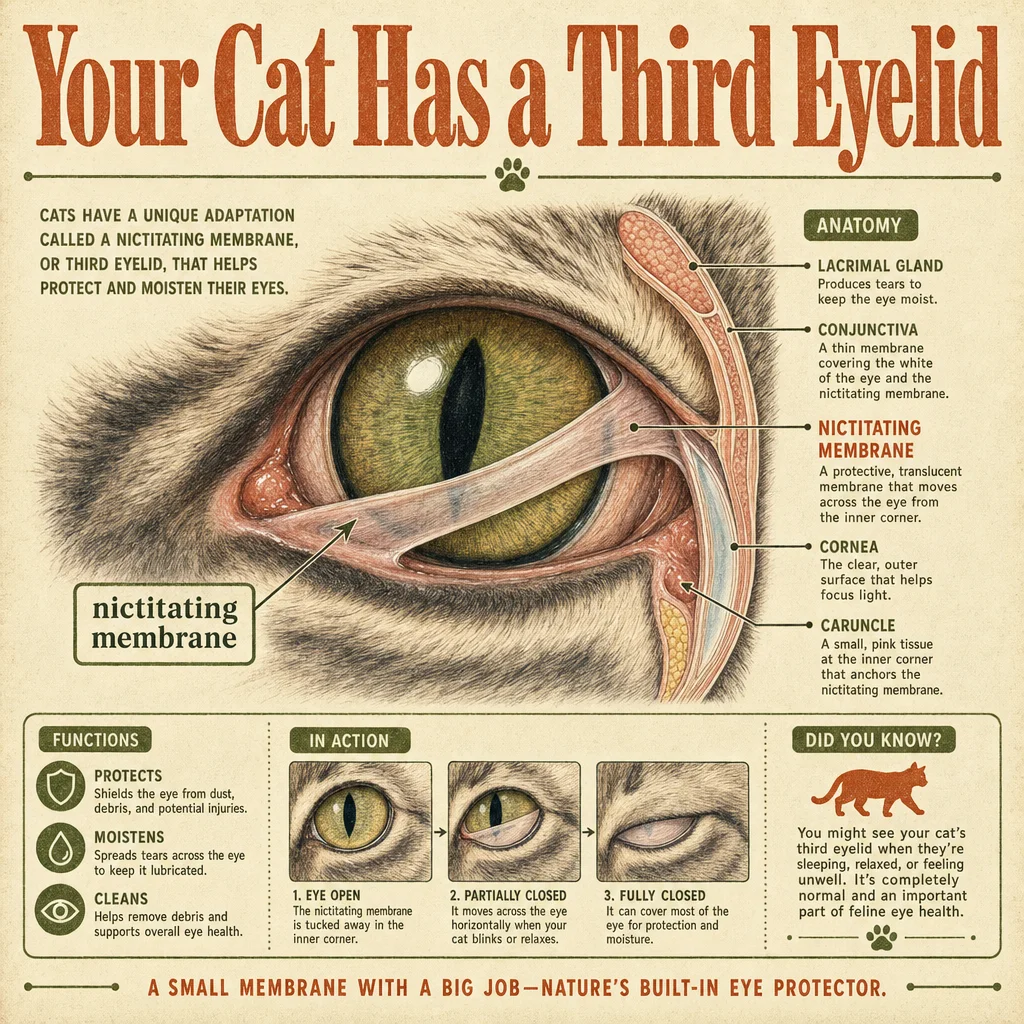
Your cat has a hidden third eyelid called the nictitating membrane — a translucent shield that sweeps horizontally across the eye from the inner corner. Cats can't actively control it. It moves passively when eye muscles shift. And its built-in gland produces up to 50% of the cat's entire tear film.
May 24, 2026 · 11:04 PM
Gallery
Your cat has three eyelids — and the third one is almost completely invisible in a healthy cat.
It's called the nictitating membrane (from Latin nictare, to blink), and it sits tucked in the inner corner of each eye, folded out of sight. Unlike the upper and lower lids that move vertically, this one sweeps horizontally across the eyeball — from the inner corner outward. 1
But here's the strange part: cats can't actually control it. The membrane has almost no muscle fibers of its own. It moves passively — pushed outward when the muscles behind the eyeball contract and press the eye slightly inward. Blink, yawn, or sink into deep sleep, and the pressure shifts just enough to let it drift across. 2
What it's actually doing in there
The nictitating membrane isn't decoration. It carries a gland — the nictitans gland — that produces up to 50% of the cat's entire tear film. 1 That's a major share of the lubrication keeping your cat's cornea healthy every day, coming from a structure most people have never noticed.
Its job is both protection and moisture: shielding the cornea from debris, dust, and scratches during a hunt through brush, while simultaneously spreading a fresh layer of tears across the eye surface.
When you can actually see it
In a fully healthy cat, the membrane is invisible. You might catch a ghost of it in two normal circumstances: briefly right after your cat wakes from a deep nap, or mid-yawn, as the eye muscles relax and shift. Those are fine. 3
What's not fine: if the third eyelid stays visible, it's a health signal. Conditions that push it out include conjunctivitis, upper respiratory infections, corneal ulcers, glaucoma, and a condition called Haw's syndrome — where both membranes protrude bilaterally, often linked to gastrointestinal illness. If it's staying out, that's worth a vet visit.
Humans lost our nictitating membrane millions of years ago — we still have a small, useless remnant in the inner corner of our eye, the pink triangle called the plica semilunaris. Cats kept theirs. One more thing your cat has that you don't.
What's something about your cat's eyes that's surprised you? Drop it below.
Daily Cat Fun Facts — one surprising cat truth, every day.
Comments